
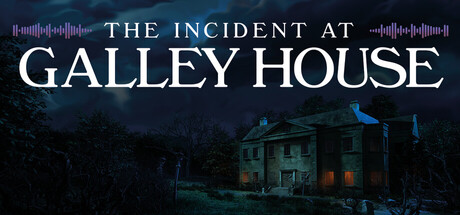
I’ve been looking forward to this game since I heard it was being worked on by the same developers as The Roottrees Are Dead, and it was well worth the wait.
John Hobbes was invited to a gathering at Galley House, and it would become the last day of his life, as this house is cursed. Nobody will be leaving this gathering alive, and John is the only one who’s body was identified. Naturally though, this is a detective game, so John isn’t our player, that would be Reya, who is now here at Galley House years after the fact with a new technology: A Spectronoetic Device, or colloquially, a Seance Machine.
Your objective today: Figure out who these 11 people are, and how they died, and ultimately figure out what the curse of Galley House is and how to put a stop to it. It’s just you and the machine, so here’s what you’re going to do.
First auto-calibrate the machine to find the spirits of the people here. That’ll give you some unidentified bodies to work with.
Then input the first two letters of the locations in the house, QU for Quail Lane, EN for Entrance, LI for Living Room, etc.
And once all that is done, the control panel will light up. You’ve got a few starting points to work from, 01-QU-1-11 for instance means to set the time dial in the top left to 01, the location slider to Quail Lane, and flip the switches for Persons 1 and 11, then when you pull the lever, you’ll see the seance. A vision of the past about what happened.
And that’s the gameplay loop. Figure out how these people moved about and interacted during the timeline of the machine, plug your guesses in, and see if a new scene is presented to you.
Compared to Roottrees, this is a very different kind of investigation. Both games feature scouring prior information to learn new information, but this game doesn’t explicitly ask you to put things together to verify that you understand what’s going on. Instead it leaves those thoughts to stew in your mind as you figure out how the curse works and how it affects the people playing out the story before you. You can fill in the names of the people in the story, and eventually put faces to names in order to have a more coherent narrative instead of watching black silhouettes with numbers on their chest talk at eachother. But ultimately none of this information is strictly required, and never gets validated as correct all the way until the credits roll where you get to see the names of the characters in the voice acter credits. Well, you do need to have put at least half the pictures correct to be able to solve the final puzzle, but ultimately matching faces to names is the easier part. The main puzzle is unwinding the timeline.
Oh right yeah, this game is fully voice acted and the backgrounds are beautifully illustrated. Everything about it is so nice to watch, and after a scene you get a full transcript of the events including sound effect transcripts such as “A car engine revs. Tires spin in the mud”, “Person 1 leaves.”, or “There’s a thunderclap”. It’s such a drastically different experience from Roottrees, where you were left to scour dry text and hope it gives you enough pointers to get you onto the next clue.
This game, like before, has an extremely competent notebook and hint system. You can bookmark any line of text to add it to your notes, and then click that line to go back to that scene. You can also paste a working scene code into your notes and click it to return to the corresponding scene on the timeline. Each scene also has a number (that you can turn off in the settings) indicating how many more scene codes you can derive from the information given. Some are very obvious, others need to be combined with information from elsewhere, or gathered through a process of elimination.
Every person is either somewhere at a given timestep, or has died and been removed from the story, so if you can keep track of the deaths (such as by leaving skull pins on the timeline), you’ll be able to keep track of which timesteps have missing scenes, and who may potentially be in them.
And if all else fails, you can use the hint button in your notebook which can give you a gentle nudge in the direction of what one of the number indicators is trying to tell you, such as “In scene XX-YY-…, Person 8 said they were talking to someone earlier, who might that be”. With further narrowing details being presented for pressing the hint button multiple times. There is no penalty at all to using this system.
Steam: https://store.steampowered.com/app/3641000 £17.75
Addendum: Since writing this, I’ve learned that The Incident At Galley House is actually a visual adaption of a previous story called Type Help, which is free to play on itch.io. The plot of the story is the same, though it is framed through scanning an old computer for files. This is the origin of the scene code system. The Incident At Galley House reworked the computer framing into a seance machine, and includes a second act to help close out the story, and tie up the loose ends in both games’ shared mystery.
Leave a Reply