
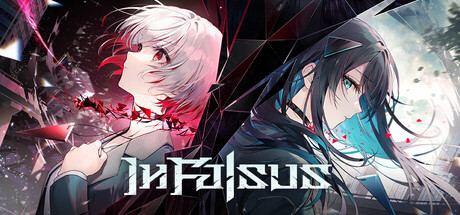
This is the part where I put the joke about the toxic yuri between In Falsus, Crystallium, and Neoditronix. It’s a mouse and keyboard rhythm game.
But don’t tell the others, I think In Falsus has done the m+kb gameplay and charting far better so far.
Anyway, In Falsus is the next project by Lowiro, and if you’ve played their previous game Arcaea, you’ll know that means two things: The gameplay will be an innovative twist on some arcade game, and the story will be utterly fucking bonkers. But it does a good job hiding that fact to begin with.
Without going into any spoilers, the story broadly reflects on a world where (a) everyone wears these weird chokers called “binds” that immediately out them for telling a lie, and reflect any heightened emotional state, though it’ll take you a bit to learn which colour is which, and (b) the misfit squad of girls you play as all get recruited into a weird government program that nobody seems to be willing to tell you what it is about.
A lot of the storytelling revolves around not immediately giving the player any answers to the questions they have. The characters will talk about a lot of the mechanics and events of the world, but of course they wouldn’t provide any exposition on those mechanics, because they are just givens for them, so it’s then left to the player to try and infer how the puzzle pieces fit together. Some of the deeper questions are answered right at the end, but not all of them. It’s a very interesting method of storytelling. Ripe for a lot of theory-crafting and puzzle solving.
The story is also where the game’s card battle mechanic is used. It forms a cycle. Clearing the story unlocks cards and encounters. Clearing encounters grants iota, Iota allows for crafting stronger cards, and then stronger cards let you advance the story more. I only ran into trouble once or twice with the system though, and if it’s really not to your taste, you can disable encounters entirely, replacing those story walls with just the requirement to pass the song.
The gameplay however is where I really enjoyed this game. The rhythm gameplay is 6 columns and a mouse slider that is locked to a horizontal region. If you’ve played a lot of Arcaea, SDVX, or especially ONGEKI, you’ll already know whats going on here. The columns are controlled with ASDF for the 4 central columns, and Shift/Space for the left and right walls. Notably, the entire game is designed so that you only need to hit buttons with your left hand. This means your right hand can stay exclusively on the mouse to hit the field and flick notes that spawn above the notefield. This I feel is where In Falsus does a far better job with its ease of access compared to other m+kb games derived from ONGEKI such as Neoditronix or MuDrive, as those games require the player to move their hands between the keyboard and mouse, and can make positioning on the buttons at speed far harder. The actual arcade game for ONGEKI does not have this issue as the controller is relatively large scaled and very easy to build the muscle memory for, whereas a keyboard has far smaller buttons, and are a lot easier to misinput on.
The game’s lifebar is loosely based on a threshold system that you’d find common in Bemani arcade games or Arcaea. Your lifebar starts pink or purple depending on if you are holding a P/FC, and then drops to blue upon your first miss. The number then indicates how many misses you are allowed to make before your lifebar turns red. If you finish the song with a red lifebar, you fail. Hitting notes will recover your life up to a maximum of +15, but if you flub your way down to -15 it can take a long time to recover back to 0. The encounter lifebar is instead based on your attack and defence vs the opponents. In the broadest terms, your health equals your base defence (with modifiers affecting incoming damage), and your attack equals the total amount of health damage you will do to the opponent through the song, not counting the critical attacks you do after performing well enough throughout a section. Early encounters can be beaten with “bigger number go brrr”, while later game encounters including a lot of enemy modifiers can be beaten with “bigger numbers really go brrrrr”.
Oh and here’s the toxic yuri I mentioned at the start: https://bsky.app/profile/did:plc:3fc46xyaqvj7av2oafwywquh/post/3me66tygfdu24
Steam: https://store.steampowered.com/app/3971950 £34.99
Leave a Reply